Police services across Canada are increasingly delivering record checks online. Identity verification remains central to that process.
Triton’s RCMP-compliant electronic identity verification enables secure online police record checks while maintaining the physical verification requirements set out under Section 5.1 of the RCMP Dissemination Policy.
In practice, identity must be verified in real time, original identification must be validated, and the applicant must be confirmed as the individual presenting that identification.
Identity Verification in an Online Record Check Process
Within an online workflow, those requirements are met through structured electronic verification designed to replace in-person processes without reducing assurance.
For police services offering online police record checks, this means:
- The applicant must be present during verification
- The identification must be authentic
- The individual must match the identification provided
Electronic identity verification may be conducted through more than one pathway.
Electronic Verification Pathways
RCMP policy permits electronic identity verification through traditional methods that rely on Canadian credit history.
For applicants with sufficient Canadian credit history, this remains an appropriate and efficient method of verification within an online police record check process.
However, not all applicants have an established Canadian credit file. Individuals who are new to Canada or younger applicants may not meet the criteria required for credit history-based electronic verification.
In those circumstances, an alternative electronic verification method must be used to confirm identity while maintaining compliant with RCMP physical verification requirements.
Triton’s live biometric electronic identity verification supports this requirement within the same online workflow.
Why Static Selfie-Based Verification is Not Used
Some identity verification approaches rely on static uploads of identification documents and selfie images. A static image does not confirm real-time presence. It does not ensure the image originates from a live hardware camera, making it a single-verification process versus a secure multi-factor authentication flow.
In today’s environment, static digital files are vulnerable to manipulation, presentation attacks, and generative AI or deepfake technologies. For these reasons, Triton does not rely on static selfie uploads for online criminal record checks. Live verification is required, providing a secure multi-factor ID verification.
How Triton’s Electronic ID Verification Meets RCMP Requirements
Triton’s electronic identity verification replaces in-person identity confirmation with a structured, real-time digital process that preserves RCMP physical verification standards.
Live Biometric Verification
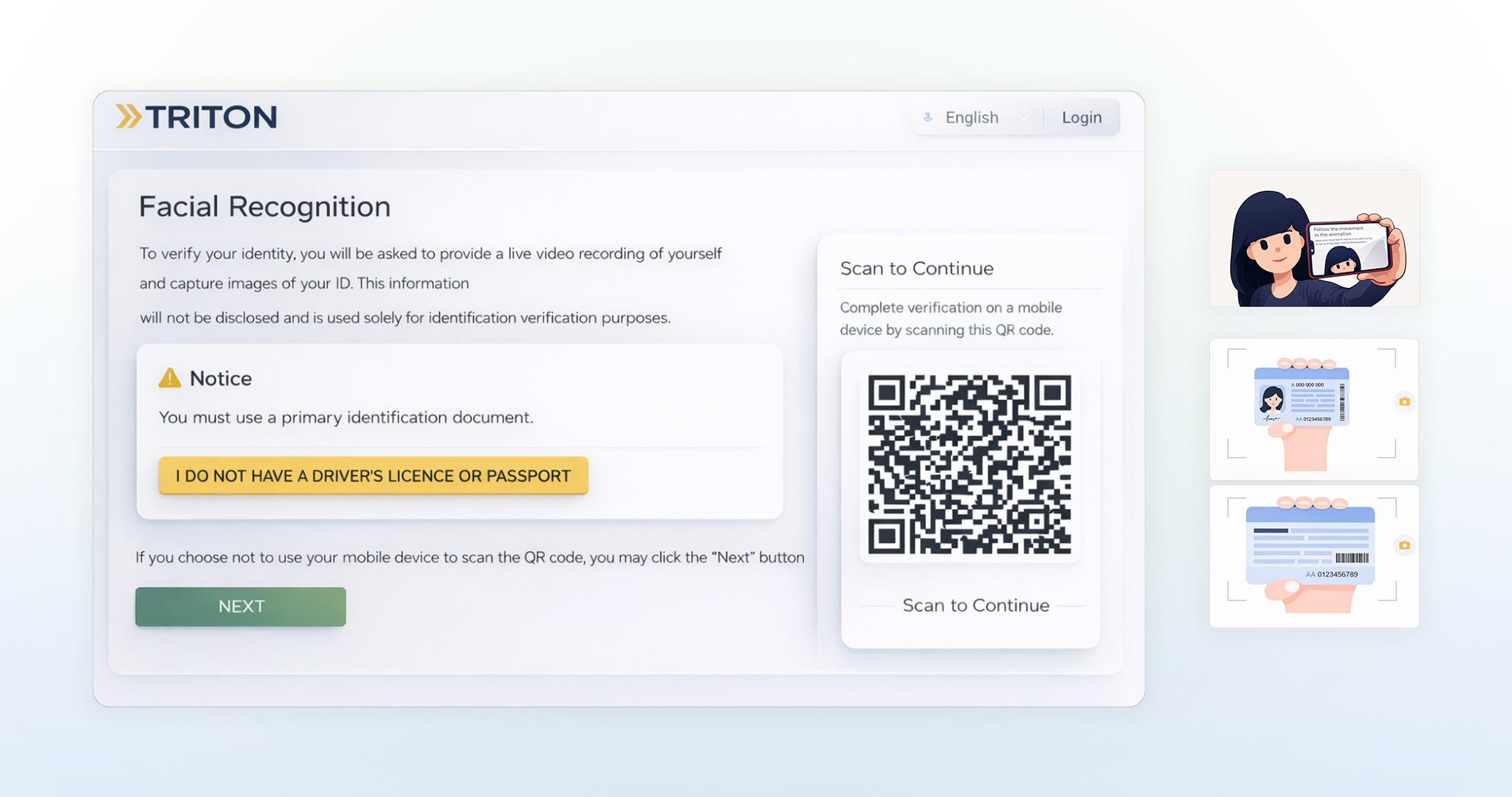
Applicants complete a live video session using a device equipped with a camera. Certified liveness detection confirms that a three-dimensional person is present during the session.
Injection attack detection verifies that the image stream originates from a live hardware camera, preventing the use of AI-generated files or prerecorded media.
This ensures identity verification is conducted in real time and not through static digital uploads.
Government ID Validation
Following live verification, applicants capture images of their government-issued identification, front and back.
The system validates the document against known templates and confirms key security elements, including barcode consistency where applicable.
This supports verification of original identification documents within an electronic workflow.
Biometric ID Confirmation
A biometric comparison is performed between the live facial capture and the photograph extracted from the identification document.
This confirms that the individual completing the record check matches the identification provided.
Together, live biometric verification, structured document validation, and biometric comparison ensure that Triton’s electronic identity verification meets RCMP physical verification requirements for online police record checks.
Integrated Within Virtual Front Counter
Triton’s electronic identity verification operates within the Virtual Front Counter platform, supporting secure online criminal record checks without requiring in-person attendance.
Members of the public can apply online. Police services retain assurance that identity verification remains aligned with RCMP standards.
Digital delivery fulfills physical verification requirements electronically while maintaining compliance.
Responsible Data Handling
Strong identity verification must also protect applicant information.
Triton’s Trust Stamp technology converts biometric data into Irreversibly Transformed Identity Tokens (IT2), which cannot be used to reconstruct the original biometric image. Biometric data is encrypted at rest using AES-256 and protected in transit using TLS 1.2 or higher.
Retention policies are configurable, including zero-retention options, allowing police services to manage data in accordance with their operational and privacy requirements.
Maintaining Standards While Modernizing Service Delivery
Online police record checks must be both accessible and secure.
Triton’s RCMP-compliant electronic identity verification:
- Requires live biometric verification
- Incorporates certified liveness detection
- Detects injection attacks and AI-generated media
- Does not accept static selfie uploads
- Validates original government-issued identification
- Confirms identity in real time
Modernization should not weaken identity assurance. With the right controls in place, it does not.
For police services considering online police record check solutions, Triton’s electronic identity verification remains secure, compliant, and aligned with RCMP physical verification requirements.